This page comes from docs/ACCESS.md in the repository.
Pupitre has no login of its own. The key access.mode has two values: open and authzen. The block access is mandatory and has no default, so no instance gets the mode open by error. Part 3 of the specification has the rules.
The two modes
open | authzen | |
|---|---|---|
| Token | None. The subject is -. | An identity token on each request |
| Who guards the page | The reverse proxy | The edge and the PDP |
| Questions | None | One or more for each operation |
run.apply and command.run | Refused with 403 apply_disabled, unless runner.allow_apply_in_open_mode = true | Decided by the PDP |
| The two ProcurAuth routes | 404 not_found | Served |
In the mode open, a reverse proxy MUST authenticate each person before the main listener. The proxy MUST send the public name of the service in Host, and server.allowed_hosts MUST list that name (7.4 of the specification). Pupitre then trusts each request. The mode writes the warning access.mode_open at each start.
The mode authzen
In the mode authzen, Pupitre is a PEP of ProcurAuth. An edge signs an identity token and sends it in a header. Pupitre checks the token, then asks a decision point (PDP) before each operation. A PDP that does not answer gives 503, never a grant.
This access block makes Pupitre check the tokens of an edge and ask a PDP:
access {
  mode = "authzen"

  identity {
    header           = "X-Identity-Token"
    issuer           = "https://edge.example.invalid"
    audience         = "pupitre"
    public_keys_file = "/run/secrets/edge/jwks.json"
    max_age          = "5m"
    clock_skew       = "1m"
  }

  pdp {
    url             = "https://pdp.example.invalid:4182"
    token_file      = "/run/secrets/pdp/token"
    ca_file         = "/run/secrets/pdp/ca.pem"
    plain_http      = false
    timeout         = "500ms"
    cache_ttl       = "30s"
    max_connections = 4
  }
}
The key access.identity.audience is the service id. It is also the member server of the action document. The credential of Pupitre at the PDP goes in a header Authorization: Bearer. It is a secret, so the file accepts it only with _env and _file.
The public keys of the edge are a JWK Set or PEM text, with 1 to 16 keys. A JWK Set with more than one key needs a different kid in each key. A PEM key gets its RFC 7638 thumbprint as kid. A token with the sub value -, external or import gives 401 unauthenticated, because the history uses these names.
Keep access.options_max_questions at 8 or more with runner.enabled = true, and at 4 or more with runner.enabled = false. One item can need that many questions. A lower value stops the start. The default is far above the minimum.
The resource tree
The tree has the service, the environments, the units and the hosts. A grant on a node covers each node below it, also a node that a person adds later.
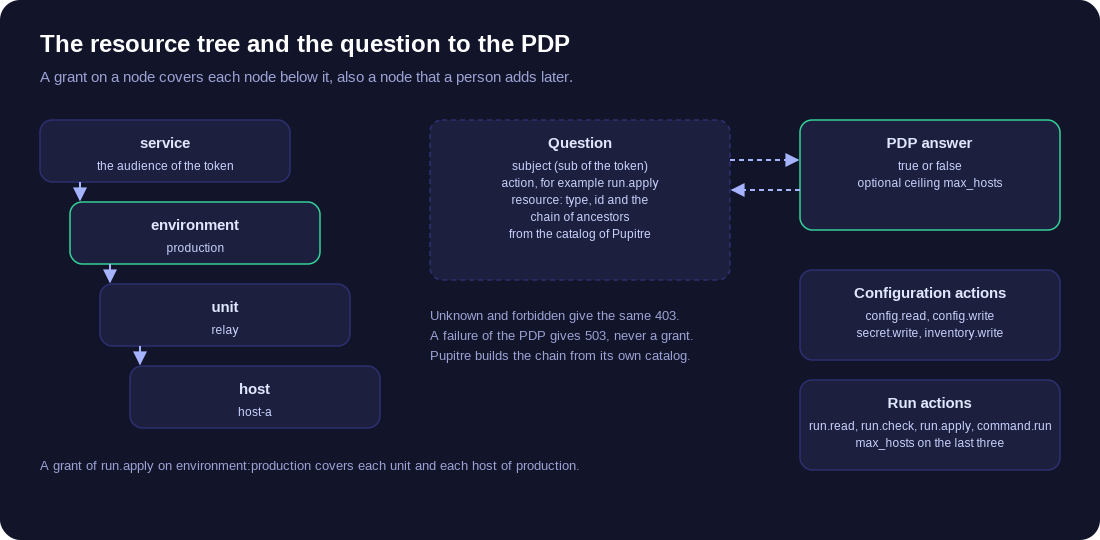
A host node is always below a unit. The same host in two units is two nodes. A grant of run.apply on environment:production covers each unit and each host of production, now and later. Pupitre builds the chain of ancestors of a node from its own catalog, never from a value of the request.
The actions
| Action | What it permits |
|---|---|
config.read | Read the documents, the effective values, the provenance, the history and the metadata of the secrets. Never a secret value. |
config.write | Write the values of a layer: common on an environment, unit_values on a unit, host_values on a host. |
secret.write | Set and delete a secret of an environment or a unit. No action reads a secret value. |
inventory.write | Create, change and delete environments, hosts and units. |
run.read | Read the runs, their events and their output. |
run.check | Start a check run or a status run of a unit. Cancel such a run. |
run.apply | Start an apply run of a unit. Cancel such a run. |
command.run | Start a command of the catalog, in check or apply. Cancel such a run. |
The last four actions exist only with runner.enabled = true. With runner.enabled = false, Pupitre publishes the first four actions, and the run routes give 404 not_found.
The ceiling max_hosts
The actions run.check, run.apply and command.run have the ceiling max_hosts. It is the most hosts of one run. The bound that applies is the lower of two values: runner.max_hosts, and the ceiling that the PDP gives with its answer. A run with more hosts gets 403 ceiling_exceeded. Pupitre never runs a part of the hosts.
The ProcurAuth routes
| Route | Content |
|---|---|
GET /.well-known/procurauth/actions | The action document. It needs no token. Pupitre builds it one time at start. |
GET /.well-known/procurauth/resources | The options route. It lists the children of a node, page by page, for the nodes that the subject can see. |
Both routes give 404 not_found in the mode open. They are below server.base_path.
Errors
| Status | Code | Cause |
|---|---|---|
| 401 | unauthenticated | No token, a token that is not valid, or two copies of the header |
| 403 | forbidden | The PDP answered false. The body has the member action. |
| 403 | ceiling_exceeded | More hosts than the effective max_hosts |
| 403 | apply_disabled | An apply or a command in the mode open with no runner.allow_apply_in_open_mode = true |
| 403 | approval_cannot_wait | The grant needs an approval, and no route of Pupitre can wait |
| 404 | not_found | An unknown item after the check, or a feature that is off |
| 503 | pdp_unavailable | The PDP gave no valid answer in time |
An unknown node and a forbidden node give the same answer. A subject without the right learns nothing about a unit that exists. The list routes show only the items that the subject can see.
Revoked grants
Each write and each run asks the PDP with no kept answer. A revoked grant thus stops them at once. A read route can use a kept answer for access.pdp.cache_ttl at most. Pupitre keeps only a true answer to the question access, and never a false answer. Each instance has its own cache.
Approvals
No route of Pupitre can wait for an approval. A key with a grant that has confirm cannot use that action through the API. A person never gets this refusal. Security model lists this limit.