The code is the reference: crates/inbox-core/src/proto.rs, enroll.rs and noise.rs. The same crate runs on the server and in the Android app (JNI). The cryptography exists only once.
All messages are JSON. Binary fields are standard base64 with pad characters. This document describes protocol version 5. An app that speaks another version gets close code 4426 and must be updated. Protocol 5 has no compatibility with protocol 4.
Protocol 4 replaced the shared device password with a one-time enrollment code. An account of the portal makes the code. The login of the account is the user name of the device. The device cannot change it.
Protocol 5 adds items that the owner answers: questions and approvals. It adds the effect hash, the thread of an item and the preferences of the account. It adds no cryptography.
Protocol 5 also adds the agents of a key. An agent is one program, or one conversation of a model, that asks. Several agents can share one key. The portal gives each agent an id, and the owner gives it a name. The frames of this document tell the phone which agent asked, and let the owner act on an agent.
Overview
A phone talks to the portal over one WebSocket connection. The content of the connection is a Noise session. The phone pins the public key of the server at enrollment, so only the real portal can answer it.
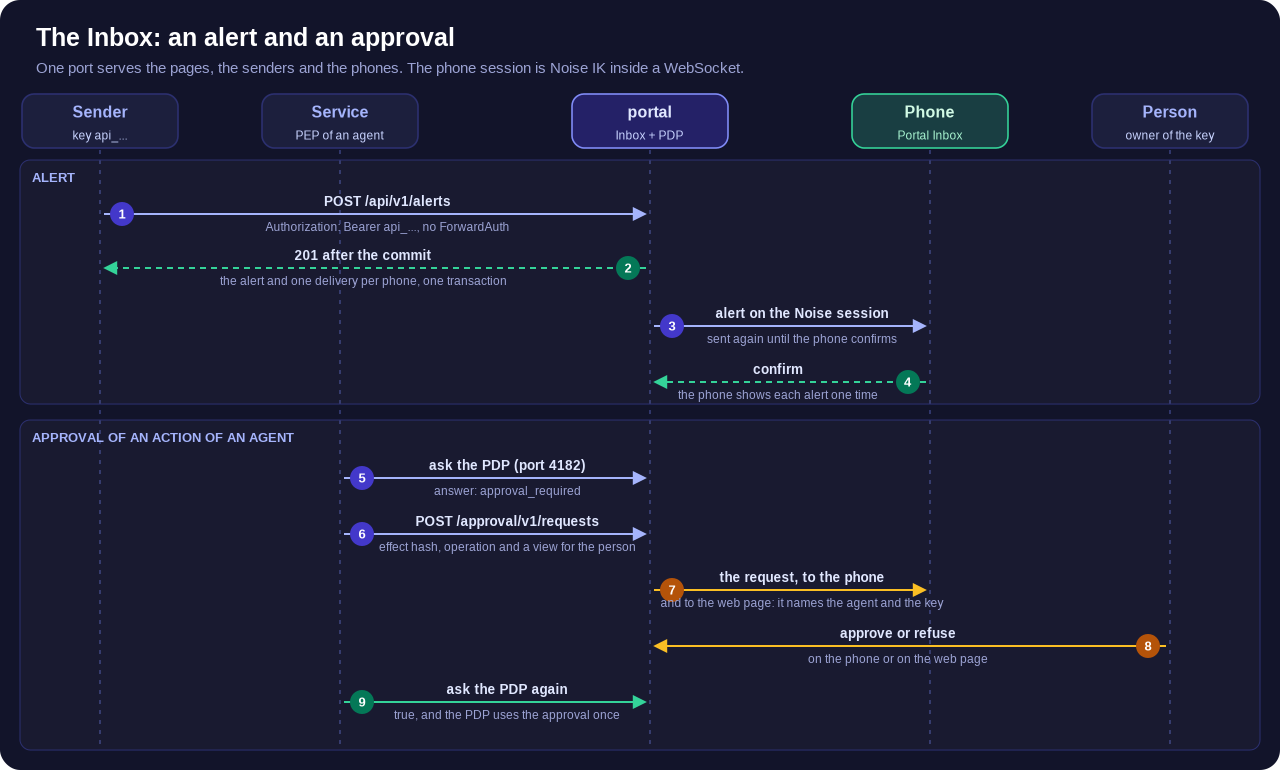
- An account of the portal makes an enrollment code. The code holds the address of the portal, its public key and a one-time secret.
- The phone enrolls with the code. It makes its own key pair. The server links the device to the account.
- At each connection, the phone proves its key and opens a session. The server sends the frames of the account to it.
- The phone sends a receipt for each frame. The server sends a frame again until the receipt arrives.
Keys
| Key | Where | Created by |
|---|---|---|
| Server Noise static key (X25519) | server key file | the command portal inbox keygen |
| Device Noise static key (X25519) | phone only | the phone, at enrollment |
| Enrollment secret (16 random bytes) | enrollment code; the server keeps only a digest | the server, for one account |
The server key file holds one line: the base64 of the 32 bytes of the private key. The public key is derived. If the file is replaced, every device and every code is invalid.
Enrollment code
The code is one text. It is also a deep link that the app opens.
portal-inbox://enroll?s=<address>&k=<server key>&c=<secret>| Key | Value |
|---|---|
s | Public base URL of the portal, percent-encoded (UTF-8). Same rules as the app: host:port, a domain, or an http(s) URL with an optional path prefix. The app adds /v1/enroll and /v1/session. 1 to 512 bytes, no white space, no control character. |
k | Public key of the server. Base64url, no pad characters, 32 bytes. |
c | Secret. Base64url, no pad characters, 16 random bytes. |
- The scheme and the host are lower case. Each of
s,kandcappears exactly once. - An unknown key, a duplicate key, a fragment, a wrong length or a bad base64 form is an error.
- White space around the whole text is ignored.
- The key
kis the pin. The app trusts no other key for this server. - The app shows the address and the fingerprint of
kbefore it connects. The fingerprint is the first 20 hexadecimal characters (80 bits) of the SHA-256 digest of the 32 bytes ofk. The app shows it in five groups of 4 characters. The person can compare it with the value of the administrator. - The secret never leaves the core. Kotlin code does not see it.
Enrollment: GET /v1/enroll (WebSocket, binary frames)
Noise_IK_25519_ChaChaPoly_BLAKE2s, prologue portal-inbox/v1/enroll. Each binary frame carries one Noise message (65535 bytes at most). The device static key is new. The phone makes it for this enrollment. The remote static key is the key k of the code.
device server Noise message 1 {"protocol":5,"secret":b64, "device_name":s,"app_version":s} -> finds the code, stores the device <- Noise message 2 {"protocol":5,"device_id":hex32, "server_name":s,"user_name":s}- Device to server, Noise message 1. The
secretis the standard base64 (with pad characters) of the 16 bytes.device_namehas 1 to 64 bytes and no control character.app_versionhas 1 to 64 bytes and no control character. - Server to device, Noise message 2.
device_idis 32 lowercase hexadecimal characters.server_nameanduser_nameare not empty.user_nameis the login of the account. - The device is enrolled only after it reads message 2. Then it stores the address, the pinned key, the device id, the device key pair and the user name.
- The server stores the device key and links it to the account before it sends message 2. If message 2 does not arrive, the code is used and the phone needs a new code.
Refusal. On refusal the server sends no message 2. It closes the WebSocket with a close code.
| Close code | Cause | Text in the app |
|---|---|---|
4410 ENROLL_REFUSED | The code is unknown, already used or expired. Message 1 cannot be read or is not valid. The limit inbox.devices.max_devices or inbox.devices.max_per_account is reached. | "The code is not valid. Ask for a new one." |
4426 PROTOCOL | Message 1 is valid but protocol is not 5. The first frame is a text frame. | "Update the app." |
4429 RATE_LIMITED | Too many attempts from this address. | "Too many attempts." |
The server uses the same code 4410 for all causes of refusal. Then an observer cannot tell a used code from an unknown code. The log of the server has the real reason (event enroll_refused). The server closes with 4429 after the upgrade. It does not answer the HTTP status 429 to the upgrade request.
A storage error closes with 1011, and the code stays unused. The server SHOULD close a connection that sends no message within 10 seconds.
Security properties:
- Only the holder of the server key can read message 1. The secret is safe from a passive observer.
- Only the holder of the server key can make a valid message 2 for this handshake. A message 2 from an earlier handshake, from another key or after a change is refused.
- A replay of message 1 is not useful. The secret works one time.
- The code is a bearer secret until the first use. Show it only to its owner.
Session: GET /v1/session (WebSocket, binary frames)
Noise_IK_25519_ChaChaPoly_BLAKE2s, prologue portal-inbox/v1/session. Each WebSocket binary frame carries exactly one Noise message (at most 65535 bytes).
- Device to server, Noise message 1 that holds
{"protocol":5,"device_id":hex32,"app_version":s}. - Server to device, Noise message 2 that holds
{"protocol":5,"server_name":s}. The device rejects any key other than the pinned server key. - Device to server, first transport frame
{"t":"ready"}. Only after this does the server count the session as established, so a replayed message 1 cannot displace a live session. - Server to device:
welcome, then the frames of the sections below.
The server closes a session that does not send ready within 15 seconds of the upgrade, with the code 1001. A ping or a pong does not extend this time. A handshake that proves no enrolled device counts as a failure of the client address. When the address has too many failures, such a handshake gets 4429. A device that proves its key always gets its session.
A client address has at most inbox.devices.max_handshakes_per_address handshakes on both routes. A new handshake of a full address ends the oldest handshake of this address with the code 1013.
Rules of all frames
Each frame is one JSON object in one Noise message. The member t names the frame. The plain text of a frame has at most 65519 bytes (MAX_PLAINTEXT).
- Closed schema. A parser refuses an unknown frame, an unknown member and a duplicate member. A frame that fails a check closes the session with an error, never a repair.
- No signature. No frame has a signature. The proof of an answer is the authenticated session and the effect hash in
shown_effect. - No new cryptography. The text of a frame is clear text inside the Noise session. No frame goes to a service. The service of an approval never speaks protocol 5.
- Ids. An id of an item, of a thread, of a delivery or of a device is 32 lowercase hexadecimal characters.
- Times. A time is an integer of Unix milliseconds. It is 0 or more.
- Texts. A limit in characters counts Unicode scalar values. A limit in bytes counts UTF-8 bytes. A line has no control character. The core crate gives
decodeandencodefor each direction. Each one applies all the rules of this document. - Size. The sender checks the size of the encoded frame. JSON escapes make a control character 6 bytes long. The server refuses an item at creation when its frame is too large.
- Optional members. An optional member is absent when it has no value. A parser also accepts
null.
Device to server
t | Members | Use |
|---|---|---|
ready | none | First transport frame. |
ack | id, stage (received) | Delivery receipt. See "Receipts". |
subscribe | group | Subscribes this device to the group. |
unsubscribe | group | Removes the subscription. |
ping | nonce (u64) | Heartbeat. The server answers pong. |
answer | see "answer" | The only answer of an item. |
reply | request_id, client_msg_id, text | A question of the owner to the agent. |
refresh | request_id | Asks for the current state of one item. |
sync | open[] of {request_id, seq}, agents[]? of {agent_id, rev} | Tells the items and the agents that the device holds. |
set_prefs | quiet?, digest? | Replaces the preferences of the account. |
agent_do | see "agent_do" | An action of the owner on an agent. |
Server to device
t | Members | Use |
|---|---|---|
welcome | see "welcome" | First frame of a session. |
alert | see "alert" | A one-way message. |
request | see "request" | An item that waits for the owner. |
message | see "message" | A turn in the thread of an item. |
settled | see "settled" | An item is final. |
digest | see "digest" | The count and the age of the open items. |
answer_result | see "answer_result" | The result of an answer or a reply. |
agent | see "agent" | The state of one agent. |
agent_result | see "agent_result" | The result of an agent_do. |
subscriptions | subscriptions[] | The groups of the device, after each change. |
pong | nonce | Answer to ping. |
error | code, message | A refusal. |
The messages set_user_name and user_name do not exist. The server refuses an unknown message. The codes of error are unknown_group, forbidden_group, unavailable, not_enabled and invalid_prefs. unknown_group: the group does not exist. forbidden_group: the account has no permission inbox.receive on the group.
unavailable: the storage or the rights are not ready, so send the message again later. not_enabled: the server does not handle this frame. invalid_prefs: a value of set_prefs is not valid. The server stored nothing. The message names the field.
A server without the blocks inbox.items and inbox.at_rest answers each of answer, reply, refresh, sync, set_prefs and agent_do so. A server with items and without the block inbox.agents answers agent_do with agent_result and the status not_enabled.
Receipts
The server sends alert, request, message, settled, digest and agent from one queue. Each row of the queue has an id of 32 hexadecimal characters. The receipt ack names this id.
| Frame | Member that holds the id of the delivery |
|---|---|
alert | alert_id |
request, message, settled, digest, agent | id |
The device stores the frame durably before it sends ack. It deduplicates on the id of the delivery. The server sends a row again until the receipt arrives. A receipt is idempotent.
Each device of an owner gets the same id for the same message, and each device has its own receipt. The frames that answer refresh and sync have a new id that is in no queue. The device stores them as any frame.
The frames answer_result and agent_result have no delivery id, and the device sends no receipt for them. The server ignores a receipt for an id that it does not know. The field alert_id of ack in protocol 4 is now id. The old name is not valid.
Frames of the server
welcome
{"t":"welcome","server_name":"Prod","groups":[{"id":"infra","name":"Infra","description":"Servers"}], "subscriptions":["infra"],"heartbeat_interval_ms":15000,"offline_warning_after_ms":60000, "server_time_ms":1788000000000,"user_name":"alice", "prefs":{"quiet":{"from":"22:00","to":"07:00","tz":"Europe/Paris","high_rings":true}, "digest":{"mode":"daily","at":"09:00","tz":"Europe/Paris"}}, "body_purge_after_ms":2592000000}| Member | Type | Rule |
|---|---|---|
server_name | string | Not empty. |
groups[] | {id, name, description} | Only the groups that the account may subscribe to. |
subscriptions[] | string ids | Groups of this device. |
heartbeat_interval_ms, offline_warning_after_ms | u64 | |
server_time_ms | i64 | |
user_name | string | Login of the account. Read-only. |
prefs | object | The preferences of the account. {} when the account has none. See "Preferences". |
body_purge_after_ms | u64 | Age at which the server erases the body of a final item. 0: the server has no items. |
The server reads prefs in the table of the account at each session. A phone that sent set_prefs gets its values back here.
alert
{"t":"alert","alert_id":"c0c0c0c0c0c0c0c0c0c0c0c0c0c0c0c0","kind":"alert","group":"infra","group_name":"Infra", "title":"Disk full on a node","created_at_ms":1788000000000}| Member | Type | Rule |
|---|---|---|
alert_id | id | Id of the delivery. |
kind | string | Always alert. A parser refuses any other value in this frame. |
group, group_name | string | An alert to one account has @direct and Direct. |
title | string | One line, 1 to 128 characters, no control character. |
created_at_ms | time |
request
A request is an item that waits for the owner. The same request_id can come again with a higher seq. The frame is then the new state of the item, for example after a revival. The device keeps one item for each request_id. A frame has the members of its kind only. The kinds of this frame are question and approval.
Members of both kinds:
| Member | Type | Rule |
|---|---|---|
id | id | Id of the delivery. |
request_id | id | Id of the item. |
kind | string | question or approval. |
chain_id | id | Id of the thread. The first item of a thread has chain_id equal to request_id. |
seq | u64 | Number of the last turn of the thread. 0 when there is no turn. |
from | object | {label, key_name, owner, via, interaction, agent_id, agent_kind, agent_state}. See below. |
urgency | string | low, normal or high. |
quiet | bool, optional | True when the item came inside the quiet hours of the account, in the time zone of the window. The server never holds an item back. The flag does not depend on urgency: the phone reads high_rings of its preferences. |
created_at_ms, chain_created_at_ms, agent_seen_at_ms | time | |
lease_mode | string | lease or until. |
lease_until_ms | time | With lease only. |
until_at_ms | time | With until only. |
allow_custom | bool | A question: a text can be the answer. An approval: a text can come with a decline. |
allow_ask_back | bool | The owner can ask the agent a question with reply. |
supersedes, previous_id | id, optional | The item that this one replaces. The item that this one follows. |
agent_label | string, optional | What the agent says that it is. Text of the agent, not verified. 1 to 64 characters, one line, with no control character, no format character and no line separator. |
from holds these members:
| Member | Type | Rule |
|---|---|---|
label | string | One line, 1 to 64 characters. The portal computes it. It is the name that the owner gave to the agent, else the key name and the number of the agent (ops-key #4). For the bucket, it is the key name when the key has the mode key, else Unattributed · and the key name. |
key_name | string | The name that the owner gave to the key. One line, 1 to 64 characters. |
owner | string | Login of the owner. One line, 1 to 64 characters. |
via | string | mcp or api. |
interaction | string | conversational or one_shot. |
agent_id | id | The agent of the item. It is the key of a group on the screen. For the bucket, it is the id of its row. |
agent_kind | string | agent or bucket. The bucket is the pseudo agent "Unattributed" of a key: it holds the items that no agent claims. |
agent_state | string | new or known. A bucket is known. The open request of a blocked or a merged agent does not exist, so no frame has these states here. |
An item of a one_shot key has allow_custom and allow_ask_back false.
The portal writes each member of from itself. None of it is text that an agent sent. A label that the agent gives never enters from: it is in agent_label, next to the explanation. The screen shows agent_label in a box marked "Not verified", and never as the name of the agent. A key that the portal does not find has the name key and the first 8 characters of its id.
The server writes agent_label from the sealed body of the item. It leaves the member out when the body has no label.
Members of a question:
| Member | Type | Rule |
|---|---|---|
title | string | One line, 1 to 128 characters, no control character, no bidi control, no line separator. |
explanation | string, optional | Text of the agent, 1 to 8000 characters. |
explanation_format | string, optional | plain (the default) or markdown. Only with explanation. See "Text format and code color". |
command | {text, label?, language?}, optional | text has 1 to 32768 bytes. label is one line of 1 to 32 characters. language is a hint for the color. See "Text format and code color". |
input | object | See below. |
hint | object, optional | {suggested, confidence?, source}. suggested and source are lines of 1 to 32 characters. confidence is from 0 to 1. |
as_of_ms | time, optional | The time of the data in the question. |
input holds type (choice, confirm, text, none or form), multiple (bool), min and max (0 to 255), options[], placeholder? and questions[]?. A choice has 2 to 8 options. Each option is {id, label, description?}. id has 1 to 32 characters of a-z 0-9 _ - and is unique. label has 1 to 48 characters.
description has 1 to 160 characters. For a choice: 1 <= min <= max <= number of options. Without multiple, min and max are 1. The other types have no option, multiple false and min and max 0.
Only text can have a placeholder of 1 to 128 characters. A text question has allow_custom false. A none question has both flags false. Only a form has questions. See "Forms".
Members of an approval: the member approval only.
Member of approval | Type | Rule |
|---|---|---|
code | string | 4 to 8 characters of A-Z 0-9. |
service | string | One line, 1 to 64 characters. |
action | string | One line, 1 to 128 characters. |
resource | string | 0 to 512 characters, no control character. Empty: the service itself. |
subject | string | One line, 1 to 128 characters. |
effect | string | sha256: and 64 lowercase hexadecimal digits. See "Effect". |
op | object | The operation. Strict rules of the effect. op and view together have at most 32768 bytes. |
view | object | {title?, fields?, body?, body_label?}. Each member is optional. See "Effect". |
explanation | string, optional | Text of the agent, not verified. 1 to 8000 characters. It is not part of the effect. |
explanation_format | string, optional | plain (the default) or markdown. Only with explanation. |
language | string, optional | A hint for the color of the command. It is not part of the effect. See "Text format and code color". |
hint | object, optional | As for a question. |
previous | {approved_at_ms, consumed}, optional | The same service, subject, action, resource and effect were approved earlier. consumed tells whether the service used it. |
follows | {code, intent}, optional | The item follows an earlier item that the owner declined with a text. The server reads it from previous_id. |
The command of an approval is the value that view.body points to in op. It is not in the frame a second time. The device computes the effect again from service, action, resource and op. It shows "Invalid request" when the result differs from effect, or when a pointer of view names no value.
{"t":"request","id":"aaaa...","request_id":"bbbb...","kind":"approval","chain_id":"bbbb...","seq":0, "from":{"label":"claude-laptop","key_name":"claude-laptop","owner":"alice","via":"mcp","interaction":"conversational","agent_id":"a1a1...","agent_kind":"agent","agent_state":"known"}, "urgency":"high","created_at_ms":1788000000000,"chain_created_at_ms":1788000000000,"agent_seen_at_ms":1788000001000, "lease_mode":"lease","lease_until_ms":1788000180000,"allow_custom":true,"allow_ask_back":true, "approval":{"code":"K7QF","service":"datastore","action":"data.write", "resource":"host:prod/database:analytics","subject":"key:claude-laptop","effect":"sha256:...", "op":{"tool":"run_write_query","host":"prod","sql":"INSERT INTO analytics.events SELECT 1"}, "view":{"title":"ClickHouse write","fields":[["Host","/host"]],"body":"/sql","body_label":"SQL"}, "explanation":"The migration needs this row."}}The complete frames are in crates/inbox-core/tests/fixtures/frames/.
message
A turn in the thread of an item.
| Member | Type | Rule |
|---|---|---|
id | id | Id of the delivery. |
request_id | id | |
seq | u64 | Number of the turn, 1 or more. |
by | string | agent or user. |
created_at_ms | time | |
explanation | string, optional | With agent. 1 to 8000 characters. |
explanation_format | string, optional | With agent and explanation. plain (the default) or markdown. |
command | {text, label?, language?}, optional | With agent. As in a question. |
text | string | With user only. 1 to 8000 characters. It is always plain text. |
An agent turn has explanation, command or both. A user turn has text and nothing else.
settled
An item is final. The device removes it from the list "to answer" and withdraws its notification.
| Member | Type | Rule |
|---|---|---|
id | id | Id of the delivery. |
request_id | id | |
state | string | answered, abandoned, expired, cancelled or superseded. |
reason | string | 1 to 32 characters of a-z 0-9 _. See below. |
by | {via, device_name?}, optional | via is phone or web. device_name is a line of 1 to 64 characters, with phone only. |
superseded_by | id, optional | With superseded only. |
decision | string, optional | approve or deny. With answered only, for an approval. |
at_ms | time |
The reasons that the server sends now are answered, lease_lapsed, until_reached, max_lifetime, agent_cancelled, agent_blocked, key_revoked, owner_deleted, admin_cancelled, superseded and item_gone. item_gone answers a refresh or a sync for an item that the server does not hold any more. The item is cancelled.
The phone that answered gets answer_result, not settled. The server sends settled to the other phones of the owner. A later version can add a reason. A device shows a reason that it does not know as it is.
digest
The open items of the owner, as numbers. It has no body. The server sends no empty digest. It sends the frame at the due time of the digest of the account. The default is inbox.items.digest, and the preferences of the account replace it.
A daily digest is due at HH:MM of each local day of its time zone. An every digest is due at the multiples of its period since the Unix epoch. Several instances of the server send one frame for each owner and due time.
| Member | Type | Rule |
|---|---|---|
id | id | Id of the delivery. |
count | u32 | Number of open items, 1 or more. |
oldest_created_at_ms | time | |
ids[] | ids | The oldest first. At most 200. Not more than count. |
answer_result
The result of an answer or a reply.
| Member | Type | Rule |
|---|---|---|
request_id | id | |
client_msg_id | string | The value of the frame of the device. |
status | string | See the table below. |
state | string, optional | The state of the item: pending, replied, answered, abandoned, expired, cancelled or superseded. |
status | Result |
|---|---|
accepted | The server took the frame. An answer is then the only answer of the item. |
already_answered | Another answer won. The same client_msg_id sent again also gets this status. |
closed | The item is final in another way. A question gets closed with no state when the answer does not fit it. Examples: an option that the question does not have, a wrong number of ticks, or a text where a choice is due. The server writes nothing, and the device drops the entry of its outbox. |
abandoned, superseded, expired, cancelled | The item is in this state. |
effect_mismatch | shown_effect is not the effect of the item. |
device_revoked | The device is revoked. The state of the item does not change, and the server closes the session with 4403. |
custom_not_allowed | The item has allow_custom false, and the frame has a text. |
ask_back_not_allowed | The item has allow_ask_back false, or the thread has the most turns that the file accepts. |
agent_locked | The agent of the item is new, and inbox.agents.lock_new is true. The frame was an accept. The item stays open and nothing is written. A decline and a reply work. |
A reply or an answer for an item that the owner does not have gets closed and no state. A frame that the server cannot handle now (the storage is away) gets the error frame unavailable. The outbox sends it again.
agent
The state of one agent. The device keeps one agent for each agent_id. It ignores a frame with a rev lower than the one that it holds.
{"t":"agent","id":"aaaa...","agent_id":"d4d4...","rev":3,"key_name":"ops-key","kind":"agent","state":"new", "label":"ops-key #4","named":false,"created_at_ms":1788000000000,"last_seen_ms":1788000500000,"open":1, "lock_accept":true, "observed":{"says":"billing-bot","says_changed":1,"client":"claude-code/2.1.0","net":"203.0.113.0/24","nets_seen":2}, "similar":{"agent_id":"a1a1...","label":"Billing bot"}}| Member | Type | Rule |
|---|---|---|
id | id | Id of the delivery. |
agent_id | id | |
rev | u64 | From 1 to 9223372036854775807. It grows at each change that a device must see. |
key_name | string | One line, 1 to 64 characters. |
kind | string | agent or bucket. |
state | string | new, known, blocked or merged. |
label | string | The text of the portal for this agent. The same rule as from.label. 1 to 64 characters. |
named | bool | True when the owner gave a name. Without a name, label is the key name and the number of the agent. |
merged_into | id, optional | With merged only, and then always. The agent that received the items. The device moves its items and follows the chain until an agent that is not merged. |
created_at_ms, last_seen_ms | time | |
open | u32 | The number of open items of the agent when the server built the frame. A change of open does not raise rev. The device counts the items that it holds. |
lock_accept | bool | True only with new and with inbox.agents.lock_new true. The server refuses accept for the items of this agent: the screen disables the button. |
observed | object, optional | The hints of the agent. A bucket has none. All text in it came from a client: it is not verified. |
similar | {agent_id, label}, optional | With new only. A known agent of the same key that looks like this one. label follows the rule of label. It is a hint, and never a merge. |
observed has these members:
| Member | Type | Rule |
|---|---|---|
says | string, optional | The last text that the agent said about itself. One line, 1 to 64 characters, with no control character, no format character and no line separator. |
says_changed | u32, optional | How many times says changed. 1 or more. Absent when it never changed. Only with says. |
client | string, optional | The name of the client. The same rule as says, with 1 to 64 characters. |
user_agent | string, optional | The header User-Agent. The same rule as says, with 1 to 128 characters. |
net | string, optional | The address range of the client: a /24 for IPv4 or a /48 for IPv6. The same rule as says, with 1 to 43 characters. |
nets_seen | u8 | The number of distinct ranges seen with the token of the agent, 0 to 8. Always present. |
The server leaves out an observed text that does not follow the rule: a bad hint never stops the frame. It leaves out observed when there is nothing to show. The first text of the agent (says_first in the engine) is for the page of the owner and is not in the frame. The server fills similar for a new agent when a known agent of the same key and the same owner matches it. The match has two rules:
- The two agents say the same text, after NFKC, lower case and one space for each run of white space.
- The two agents have the same client and the same address range.
A match on the text wins over a match on the client. With several matches, the agent that called last wins, then the lower agent_id. A blocked or merged agent is never a candidate.
The server builds similar when it builds the frame, so a rename of the known agent shows in the next frame of the new agent. A rename does not raise rev of the new agent. A device that wants the new name asks again with sync, or waits for the next change of the new agent. A device must show the sentence "Hints can be copied" with similar. The device must never merge by itself.
A bucket has the state known, named false, no observed, no similar and no merged_into. The server sends the frame of a bucket in the answer to a sync only: it never changes. The label of a bucket depends on the mode of its key. The server computes it when it builds the frame.
When the server sends it. The server writes one message for each device of the owner after each change that raises rev. These changes are a new agent, new hints and each action of the owner. A merge also writes one message for the target. It sends the message from the queue, with a receipt, so the notice of a new agent is not lost.
The frame holds the state of the agent when the server sends it. The server withdraws a message with an older rev when a newer message waits. A message goes to the devices of the owner of the agent and to no other device.
An action that changes nothing writes no message. A portal without the block inbox.agents sends no agent frame.
The device must notify the owner once, for a new agent that it did not hold before. A frame that comes again with the same rev must not notify again.
agent_result
The result of an agent_do. It has no delivery id: the device sends no receipt.
{"t":"agent_result","client_msg_id":"m-0010","agent_id":"d4d4...","status":"ok"}| Member | Type | Rule |
|---|---|---|
client_msg_id | string | The value of the frame of the device. |
agent_id | id | The agent of the frame of the device. |
status | string | See the table below. |
status | Result |
|---|---|
ok | The action is done, or the agent was in the wanted state already. |
not_found | The agent does not exist, or it belongs to another owner. One answer for both cases. |
invalid_name | The name has a control character, a format character, a white space at an end, or a bad length. |
name_taken | Another agent of the same key has this name, after NFKC and lower case. |
bad_state | The action is not possible for the state or the kind of the agent. Examples: the bucket, a rename of a merged agent, an allow of a blocked agent, a merge into itself. |
cross_key | A merge across two keys. |
not_enabled | The server has no block inbox.agents. |
The server then sends the new agent frame to every device of the owner, the device that sent the action too.
Frames of the device
ack
{"t":"ack","id":"<32 hex>","stage":"received"}. See "Receipts".
answer
{"t":"answer","request_id":"bbbb...","client_msg_id":"m-0001","action":"accept","shown_effect":"sha256:..."}| Member | Type | Rule |
|---|---|---|
request_id | id | |
client_msg_id | string | 1 to 64 characters of A-Z a-z 0-9 _ -. The device sends the same value again until it gets answer_result. |
action | string | accept or decline. |
shown_effect | string, optional | With accept of an approval: the effect that the device computed from the op that it received. Never with decline. |
choice[] | strings, optional | 0 to 8 option ids. With accept of a question. An answer by free text has an empty list. |
text | string, optional | 1 to 8000 characters, no NUL. Never with accept of an approval. |
intent | string, optional | comment or change_request. With decline and text only. |
answers[] | objects, optional | The answers to a form: 1 to 4 entries. With accept only. It excludes choice, text, intent and shown_effect. See "Forms". |
For a confirm question the choice is ["yes"] or ["no"]. A decline of an approval is the only refusal. A decline of a question means: no answer. The user never edits the command. A change_request is a text for the agent.
reply
{"t":"reply","request_id":"bbbb...","client_msg_id":"m-0006","text":"Why this database?"}. text has 1 to 8000 characters, no NUL. The item stays open and gets the state replied.
refresh
{"t":"refresh","request_id":"bbbb..."}. The server sends the request frame of the item, or its settled frame. The request frame has the state of the item now (seq, lease). An item that the server does not hold gets settled with the reason item_gone.
sync
{"t":"sync","open":[{"request_id":"bbbb...","seq":2}],"agents":[{"agent_id":"a1a1...","rev":5}]}. open has at most 500 entries. agents is optional and has at most 200 entries, with no repeated agent_id. An entry of agents has an id and a rev of 1 or more. An absent agents means that the device holds no agent. The device sends sync at each session, so the list of agents is the way to catch up.
The server sends the request frames that the device lacks or knows in an older state. It sends a settled frame for each item that is final or that it does not hold any more. It sends nothing for an item that the device holds in the newest state.
The server also sends the agent frames that the device lacks, before the items. It sends an agent that the device does not list, unless the agent is idle, blocked or merged. It sends an agent that the device lists with an older rev, whatever its state. It sends nothing for an agent that the device holds in the newest rev.
An agent is idle when it has no open item and made no call for inbox.agents.idle_after. A bucket is never idle. These frames have a new delivery id that is in no queue. A phone that sends a list of 200 agents with 500 items still fits in one Noise message.
agent_do
One action of the owner on an agent. The device asks for no biometric: only an approval needs one.
{"t":"agent_do","agent_id":"d4d4...","client_msg_id":"m-0010","op":"allow","name":"Refund cleaner"}| Member | Type | Rule |
|---|---|---|
agent_id | id | |
client_msg_id | string | 1 to 64 characters of A-Z a-z 0-9 _ -. The device sends the same value again until it gets agent_result. |
op | string | rename, allow, block, unblock or merge. |
name | string, optional | With rename (always) and allow (optional). 1 to 32 characters, with no NUL. |
into | id, optional | With merge only, and then always. The agent that receives the items. |
A block and an unblock have no other member. A frame with a member that its op does not take is a protocol error. The parser checks the length of name only. The server checks the other rules of a name and answers invalid_name. A merge into the agent itself is well formed: the server answers bad_state.
The server answers agent_result. Every action is idempotent: the same frame again gives ok and writes nothing. The actions are:
rename: gives a name to the agent, or changes it.allow: changesnewtoknown. With a name, it also gives the name.block: changesneworknowntoblocked. The server cancels the open items of the agent with the reasonagent_blocked. The calls of the agent getagent_blocked.unblock: changesblockedtoknown. It brings nothing back to life.merge: moves the items of the agent tointo, in the same key. The agent becomesmerged.
The owner of the agent is the account of the device. An agent of another account gets not_found.
set_prefs
The frame has the members of prefs. It replaces the preferences of the account. An absent block means: no preference of the account, use the default of the file of the portal.
The server checks the frame before it stores it. The time zone names must be in the time zone database of the server, with the exact capital letters. The period every_h must be from 1 to 168. A value that is not valid gets the frame error with the code invalid_prefs. The message names the field, the expected form and the value. The server stores nothing in this case, and the session stays open.
A valid frame gets no answer. The next welcome has the stored values. The page Inbox > Preferences of the owner reads and writes the same values. A change on the page reaches a connected phone at its next welcome: the protocol has no frame that pushes the preferences.
The server uses the preferences in two ways. It sets the member quiet of a request that arrived inside the quiet hours. It also sends the frame digest at the due times of the account. The server never holds a request back.
Preferences
| Member | Type | Rule |
|---|---|---|
quiet | object, optional | {from, to, tz, high_rings}. |
quiet.from, quiet.to | string | HH:MM, 24 hours. They differ. The window can cross midnight. |
quiet.tz | string | Name of a zone of the time zone database of the server, with its exact capital letters. 1 to 64 characters of A-Z a-z 0-9 _ + - /. |
quiet.high_rings | bool | True: an item with the urgency high still rings. |
digest | object, optional | {mode, at?, tz?, every_h?}. |
digest.mode | string | off, daily or every. |
digest.at, digest.tz | string | With daily only, and both. tz follows the rule of quiet.tz. |
digest.every_h | u16 | 1 to 168. With every only. |
off has no other member.
Text format and code color
The explanation of an agent is a text that the portal does not trust. It can be plain text or Markdown. The member explanation_format tells which one: plain (the default) or markdown. The member exists in the frames request (a question and an approval) and message (a turn of the agent).
No other text has a format. A command, an answer, a reply and a comment of the user are always plain text.
The device and the server read Markdown with one implementation in the core crate (render::markdown). The result is a closed tree. A construct that is not in the list below stays plain text, as the author wrote it. A parser never fails: a text over a limit becomes one block of plain text.
| Kept | Plain text |
|---|---|
| Paragraphs, soft and hard line breaks. | Raw HTML. |
| Headings of level 1 to 3, shown as bold lines. | Images, tables and footnotes. |
| Emphasis, strong text and inline code. | Autolinks, thematic breaks and headings of level 4 to 6. |
| Fenced and indented code blocks, with a language from the info string. | |
| Block quotes. | |
| Ordered and unordered lists, with a depth of 3 or less. | |
Task items (- [ ] and - [x]), shown as a read-only box. | |
| Links, shown as text with the host in parentheses. |
A link is never active. The screen shows its text and, in parentheses, the host of the address. Only the schemes http and https have a host. A link with another scheme (for example javascript: or data:) shows its text only.
The host is the part after the user information, so https://good.example@bad.example/ shows bad.example. A host with a character other than a letter, a digit, a dot, a dash or a port number gives no host.
The limits are an input of 8000 characters (the limit of an explanation), 2000 nodes and a depth of 4 levels. A quote, a list item, an emphasis or a link is one level. A list can have 3 levels of lists at most. A text over one of these limits is shown as plain text. The server checks the length at creation. It does not check the other limits.
A screen shows a character that can hide text (a bidi control, a zero-width character, a control character) as a visible mark such as U+202E. The screen never removes it.
The member language is a hint for the color of a command. It exists in command (frames request and message) and in approval. The value is one of plain, sql, json, yaml, toml, bash, python, rust, javascript, typescript and diff. Any other value, in any other case, is an error. The language never changes the text: it only gives color.
The core crate colors code with hand-written tokenizers (render::highlight). The result is a list of tokens that covers the text with no gap. A token has a start, an end and a class. The classes are keyword, string, number, comment, function, type, operator, punctuation and plain. The language diff adds the classes add, del, hunk and meta.
A string or a comment that is not closed runs to the end of the line. Where the language lets a string span lines, it runs to the end of the text.
The JNI functions markdownParse(text) and highlightTokens(language, text) give these results to the app. markdownParse returns the JSON of the tree. highlightTokens returns a JSON array of [start, end, "class"]. The offsets are in UTF-16 code units, as Kotlin counts a string.
A Markdown explanation that the owner reads on the phone:
{"t":"request","kind":"question","title":"Purge the staging data?", "explanation":"The purge frees **40 GB**.\n\n```sql\nSELECT count(*) FROM staging.events;\n```", "explanation_format":"markdown", "command":{"text":"DELETE FROM staging.events WHERE ts < '2026-11-01';","label":"SQL","language":"sql"}}The complete frames are request-question-markdown.json, request-approval-markdown.json and message-agent-markdown.json.
Forms
A form is a question with several questions in one request. Its input.type is form. The member input.questions[] has 1 to 4 items. The members multiple, min, max, options and placeholder of input are empty (false, 0, 0, an empty list, absent).
| Member of a question | Type | Rule |
|---|---|---|
id | string | 1 to 32 characters of a-z 0-9 _ -. It is unique in the form. |
header | string | A short label. One line of 1 to 16 characters. |
text | string | The question. 1 to 600 characters. It can have line breaks. It is plain text. |
type | string | choice or text. |
multiple, min, max, options[] | The rules of a choice input, for a choice question. A text question has no option, multiple false and min and max 0. | |
placeholder | string, optional | With text only. 1 to 128 characters, one line. |
The flags of the item apply to the whole form. With allow_custom, each choice question has a row "Other" with a free text. The free text is exclusive of the ticks of the same question. A form that has no choice question cannot have allow_custom.
With allow_ask_back, the owner can ask the agent a question. The form stays open. A form on a one_shot key is an error: a closed automatic system gives one decision. A form is a question, so it never has an approval.
The answer of a form has answers[] and action accept. It has one entry for each question and no other entry. An entry is {question_id, choice[]?, text?} with exactly one of choice and text. choice has 1 to 8 option ids with no repeat. text has 1 to 8000 characters, no NUL. For a choice question, text is the free answer.
The parser checks only the shape: 1 to 4 entries, unique question_id, and the rules of the entry. The server checks the ids, the number of ticks and the free text against the form of the item. It uses validate_form_answer(questions, allow_custom, answers) of the core crate. A device can call the same function before it sends the answer.
{"t":"answer","request_id":"bbbb...","client_msg_id":"m-0004","action":"accept","answers":[ {"question_id":"target","choice":["staging"]}, {"question_id":"checks","choice":["unit","e2e"]}, {"question_id":"window","text":"Friday morning"}, {"question_id":"note","text":"Use the blue pipeline."}]}The complete frames are request-question-form.json and answer-form.json.
The largest form (4 questions with 8 options at the maximum length) fits in one Noise message. The sender still checks the size of each frame. The answer of a form can be larger than one message when each text has the maximum length in a script with 3-byte characters. The sender refuses such a frame.
Effect
The effect binds a service, an action, a resource and an operation (op). The rule is paragraph 17.3 of the ProcurAuth protocol. The code is crates/inbox-core/src/effect.rs. The server, the phone (through JNI) and the tests use this code.
- Make the JSON object
{"v":1,"service":..,"action":..,"resource":..,"op":..}. - Write it as JCS text (RFC 8785). Put no white space between tokens. Sort the members by UTF-16 code unit. Use the short escapes
\b \t \n \f \r \" \\. Write each other character below U+0020 as\u00xxin lower case. - Encode the text in UTF-8 and compute SHA-256.
- The effect is
sha256:and the 64 lowercase hexadecimal digits.
op is an object. It has objects, arrays, strings, true, false, null and integers. An integer has no fraction and no exponent. Its absolute value is at most 2^53-1. Any other number makes op invalid, for example 1.5, 1.0, 1e2, -0 and 9007199254740992.
A duplicate member name makes op invalid. An op that is not an object is invalid. The code for an invalid op is invalid_op. The core parser of op refuses it while it reads the frame.
A view is a template over op. It is not part of the effect.
Member of view | Rule |
|---|---|
title | Optional. One line, 1 to 128 characters. Absent: the screen shows the name of the action. |
fields[] | Optional. 0 to 12 pairs [label, pointer]. label is one line of 1 to 48 characters. Absent: no field. |
body | Optional. A pointer to the command. It names a string. Absent: the request has no command text. |
body_label | Optional. One line, 1 to 48 characters. It has no effect without body. |
The view {} is valid (protocol 17.9). The phone and the web page then show the name of the action as the title and no field. They show no command text, and a fixed sentence says that the service gave no command. A frame can omit a member of view. The phone of version 5.4.0 reads only a view with title, fields and body, and it shows another view as invalid.
A pointer is an RFC 6901 JSON Pointer of at most 256 bytes. It must name a value of op. A pointer of fields[] names a string, an integer, true, false or null. It does not name an object or an array. A bad view gives the code invalid_view.
The short form of an effect for the screen is its first 8 hexadecimal digits. The screen shows it after sha256:.
The JNI functions effectCompute(service, action, resource, opJson) and viewResolve(opJson, viewJson) give these results. Both return JSON text: {"effect":"sha256:..."}, {"view":{...}} or {"error":{"code","message"}}. In view, the members title and body are absent when the view has none. The vectors of the rule are in crates/inbox-core/tests/fixtures/effect-vectors.json.
States of an item
| State | Open | Use |
|---|---|---|
pending | yes | The agent waits. The lease is alive. |
replied | yes | The owner asked the agent a question. The item stays open. |
answered | no | One answer won. A decline of an approval is answered with the decision deny. |
abandoned | no | The lease and its grace ended. The agent can revive the item in the window of the server. |
expired | no | The date of the agent or the longest life was reached. |
cancelled | no | The agent, an administrator, a revoked key or a deleted owner closed it. |
superseded | no | The agent made a new item in the same thread. |
Only one answer wins. The server decides, not the clock of a phone. The other devices of the owner get settled.
Delivery rules
- Fan-out at acceptance. When an alert is accepted, one delivery row is created for every device subscribed to the group at that instant. An alert of the portal about a service has a row only for the devices of the accounts that may open the service. An item has a row for each device of its owner that is not revoked. A change of an agent has a row for the same devices.
- Retransmission. The server sends rows whose receipt has not arrived yet, oldest first, with at most
max_inflightrows in flight. A row that stays without receipt forresend_afteris sent again, and the whole backlog is resent after every reconnection. - Order on the device. The app stores the frame durably before it sends
ack received, and deduplicates on the id of the delivery. Notifications use an identifier derived from this id, so a retransmission never shows twice. - Outbox. The device keeps each
answerand eachreplyuntil it getsanswer_result. It sends them again after each reconnection. - Items have no age limit. An item stays in the queue until the device confirms it. The lease and
max_lifetimeend an item.storage.delivery_ttldoes not apply to an item. - Catch-up. A device that enrolls after an item came gets the open items of its owner at its first session. The same holds at each reconnection. A device that is away gets the items that it lacks. A device gets the agents that it lacks with its
sync. See "sync". - Order. The server sends
request,messageandsettledin the order of the queue. A device that was offline gets therequestbefore itssettled. - Abandoned items. An item that is
abandonedwhen its first delivery is due does not go to a device that never got it. The server withdraws the deliveries of this item for this device. A revival sends a newrequest. - Out of date. The server withdraws a
settledfor an item that is open again, and a delivery that it cannot build. - Expiry. A delivery not received within
storage.delivery_ttlis no longer sent and is reported as expired. A revoked device's rows are abandoned.
Rights of the account
A phone subscribes only to a group for which its account has the permission inbox.receive of the portal features.
- The
welcomelists only the groups that the account may subscribe to. subscribeto another group gets the errorforbidden_group. Sometimes the portal cannot tell the rights, because its directory is not ready or is old. Then the error isunavailable, and the phone can send the message again.- When the account loses the permission, the server removes the subscription and sends
subscriptions. This check runs when the directory of the portal changes, and at eachwelcome. It does not run for each alert. - The server never removes a subscription when it does not know. A directory that is not ready, a directory that is old, an empty directory and an account that the directory does not know remove nothing.
- An alert that exists is always delivered. A phone that loses the permission still gets the alerts that the server made before.
- An alert of the portal about a service (
inbox.watch) is an exception. The server sends it only while the account of the phone may open the service. When the account lost the access, the server removes the delivery from the backlog. When the portal cannot tell, the delivery waits. - An item goes only to the devices of its owner. No other account receives it.
An alert to one account
An alert can be for one account, not for a group. The frame is the same frame. It has the group id @direct and the group name Direct. The id of a group of the file has only the characters a-z, 0-9, - and _, so the two never collide. The server sends the frame to each phone of the account that is not revoked, with no subscription. The phone never subscribes to @direct.
The kind of a message
The kinds are alert, question, approval, turn and digest. A parser refuses any other value. The kind alert is also a member of the frame alert. The server stores the kind in the column kind of the table alerts. The kinds map to frames:
alert to alert, question and approval to request, turn to message and digest to digest. The rule of one-way messages stays true for alert only. The other kinds have an answer from the device.
Close codes
| Code | Use | App behaviour |
|---|---|---|
| 1012 | The server restarts | Reconnect immediately. |
| 1001 | Session timeout or handshake timeout | Reconnect. |
| 1013 | A newer handshake from the same address took the place, or this instance does not know the account of the phone (PostgreSQL) | Reconnect after a back-off. |
| 4401 | Unknown device or key mismatch | Enroll again. |
| 4403 | Device revoked | Enroll again. |
| 4409 | Replaced by a newer session of the same device | Do not fight it. |
| 4410 | Enrollment refused (only on /v1/enroll) | Ask for a new code. |
| 4426 | Unsupported protocol | Update the app. |
| 4429 | Rate limited | Reconnect later. |
The server closes the session of a device that sends a frame that fails a rule of this document.
Decisions
These choices are part of the protocol. Change them only with a new protocol version.
- Query form. The link is
portal-inbox://enroll?s=..&k=..&c=... A link with a fragment is an error. - Strict code. The parser is strict. The scheme and the key names are case sensitive. A pad character in base64url is an error. Bits at the end that are not zero are an error.
- Order of keys. The order of
s,kandcin the query is free. - Fingerprint. The fingerprint is the first 20 hexadecimal characters (lower case, 80 bits) of SHA-256 over the 32 bytes of the server key. It has five groups of 4 characters with one space between them. The core computes it. The fingerprint is not on the wire, so its length is not part of the protocol version. A different key with the same fingerprint costs about 2^80 digests.
- No reason on refusal. The server sends 4410 for every refusal that concerns the code or message 1. It sends 4426 only when message 1 is valid and the version is wrong, or when the first frame is a text frame.
- Lifetime of a code. The server decides. A code works one time. The key
inbox.enrollment.code_ttlsets its life (default 10 minutes). The server compares the digest of the secret in constant time. - Server key file. One line, base64 of the 32 private bytes. No version byte.
- Device name. The app trims it and shows the phone model as default. The server checks 1 to 64 bytes and no control character, and does not trim.
- Login is read-only. The phone stores
user_namefrom message 2 and updates it at eachwelcome. The phone has no option for it. - Upgrade of the app. The upgrade of the local database of the app to version 9 removes every stored portal of an earlier protocol. The app tells the person once: "Enroll again". The upgrade to version 10 drops the stored items only. The portal sends the open items again at the next
sync. - Timeouts of the app. It waits 20 seconds for the WebSocket to open and 90 seconds for message 2. The server SHOULD close an enrollment connection that sends no message 1 within 10 seconds.
- One attempt. An enrollment connection carries one handshake. The server closes it after message 2 or after a refusal. The phone closes it with code 1000.
- Identity on the phone. The identity of a portal on the phone is local. The phone derives the fingerprint from the pinned key. The server never sends a display name that the phone trusts.
Other interfaces
The page of the Inbox is a page of the portal, at /auth/settings/inbox. It needs a session of the portal. The senders send alerts to the same listener of the portal, on /api/v1/. The routes are in the HTTP reference and in the Inbox guide. The protocol of the phones has no admin call.
Source of this page: docs/inbox/protocol.md.